In 1939, a doctor at Duke University began feeding desperately ill patients a diet centered around white rice, fruit, fruit juice, and sugar.
Not exactly what most people would call a “health food.”
Some patients consumed astonishing amounts of sugar each day. Yet nearly all of them improved.
Their blood pressure dropped dramatically.
Their diabetes improved.
Their failing kidneys began functioning better.
Some patients with severe retinal damage — the kind modern medicine still often treats with lasers because the damage is assumed to be permanent — actually showed healing.
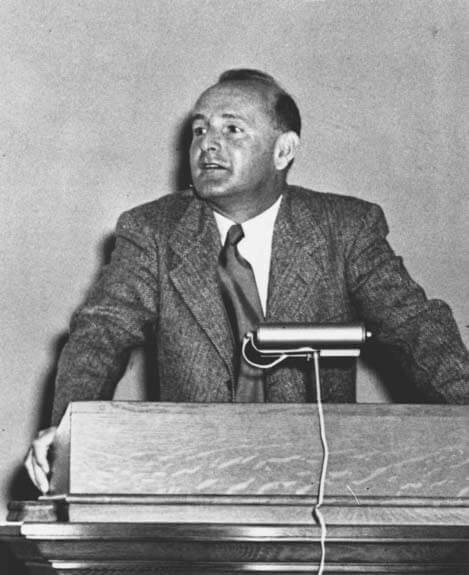
The doctor was Walter Kempner.
And his work remains one of the strangest and most fascinating chapters in the history of nutrition science.
A Diet for the Sickest Patients
Kempner developed what became known as “The Rice Diet” at Duke University in North Carolina.
This wasn’t a casual wellness program for healthy people trying to lose ten pounds before summer.
These were often extremely sick patients:
- malignant hypertension,
- kidney disease,
- severe obesity,
- advanced diabetes,
- heart failure.
Many had conditions that medicine at the time considered nearly hopeless.
Dr. John McDougall later described Kempner as:
“The father of modern day diet therapy.”
McDougall also made clear that the Rice Diet was reserved for the seriously ill:
“The treatment was a simple therapy of white rice, fruit, juice, and sugar, and was reserved for only the most seriously ill patients.”
The original Rice Diet was extraordinarily low in fat and sodium.
Patients ate:
- white rice
- fruit
- fruit juice
- sugar
- with very small amounts of protein and almost no fat.
To modern ears, it sounds almost absurd.
Especially because many patients with diabetes improved eating large amounts of carbohydrate and sugar.
The Results Were Difficult to Ignore
Kempner documented his results obsessively.
And unlike many modern nutrition influencers, he didn’t rely on testimonials alone.
He used:
- blood pressure measurements
- laboratory markers
- photographs
- retinal imaging
- chest x-rays
- and long-term clinical follow-up
Some of the most dramatic evidence involved the retina.
The tiny blood vessels in the eye provide a direct window into damage happening throughout the body.
Patients arrived with retinal hemorrhages, leaking blood vessels, and swelling associated with severe hypertension and diabetes.
After months on the Rice Diet, many improved dramatically.
The before-and-after retinal photographs are still startling to look at today.
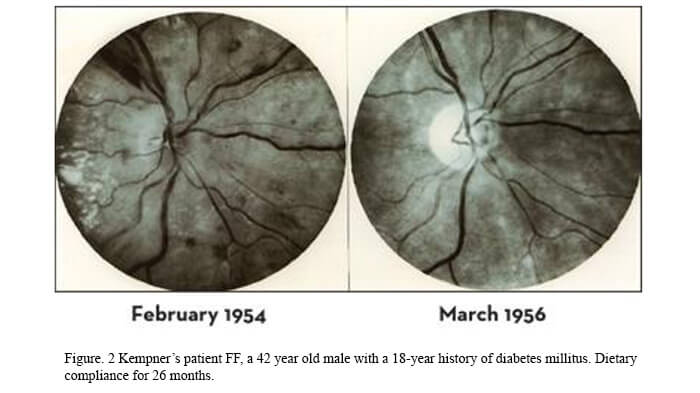
McDougall wrote:
“The Rice Diet stops the bleeding (hemorrhages) and leaking (exudates) from blood vessels.”
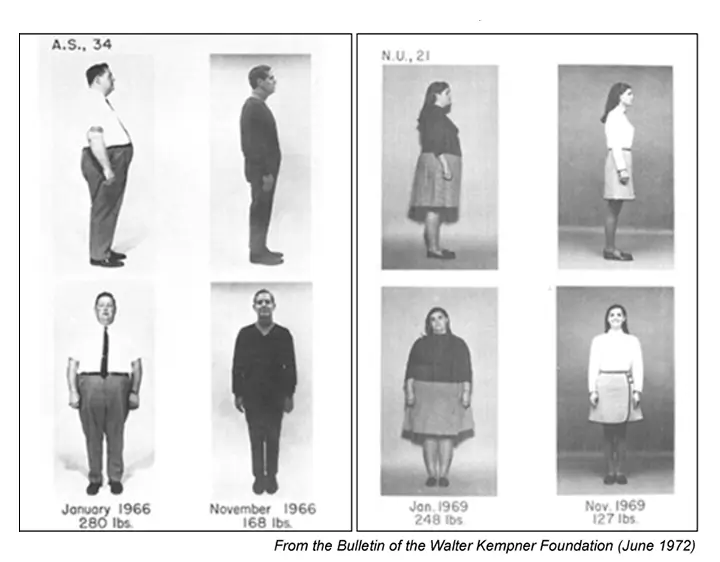
Kempner also reported major reductions in blood pressure, improvement in kidney function, reversal of edema, and dramatic weight loss in obese patients.
One report cited by McDougall described massively obese patients losing an average of 141 pounds.
Why Would This Work?
This is where things get interesting.
Most people assume sugar itself is the central driver of modern metabolic disease.
Kempner’s results suggested something more complicated.
His approach was based on dramatically reducing the overall metabolic burden placed on the body.
The Rice Diet was:
- extremely low in fat
- extremely low in sodium
- very low in protein
- and based primarily on easily digested carbohydrates
The body, in effect, was being given a kind of metabolic “rest.”
Today, many whole-food plant-based physicians still emphasize a similar principle:
when people eat foods with very low calorie density and very low fat content, weight often falls naturally and metabolic markers improve.
This is one reason physicians like Nathan Pritikin, Dean Ornish, Caldwell Esselstyn, and John McDougall all acknowledged Kempner’s influence.
McDougall’s Important Distinction
But here’s something important.
Even McDougall — one of the strongest advocates of starch-based nutrition — did not present the Rice Diet as an ideal long-term eating pattern for most healthy people.
Kempner’s program was closer to an emergency medical intervention.
A therapeutic tool.
McDougall’s own approach was broader and more practical:
- potatoes
- rice
- beans
- corn
- oats
- vegetables
- fruit
- with greater nutritional variety and sustainability
In other words: the Rice Diet was not meant to be gourmet cuisine.
It was medicine.
And in many cases, remarkably effective medicine.
A Forgotten Chapter in Nutrition History
Today, the Rice Diet is rarely discussed.
Modern medicine largely moved toward:
- pharmaceuticals
- procedures
- and highly specialized interventions
Yet Kempner’s results remain sitting there in the medical literature like an uncomfortable historical artifact.
Because they raise a difficult question:
What if many chronic diseases are not simply caused by carbohydrate itself…
…but by the overall excesses of the modern Western diet?
Too much:
- fat
- processed food
- calorie density
- sodium
- and metabolic overload
Kempner may not have had every detail right.
His diet was highly restrictive and probably not ideal as a permanent lifestyle.
But the larger lesson may still matter.
When people dramatically lower calorie density…
reduce dietary fat…
eat simple starch-based foods…
and allow excess weight to come off…
the body often has a far greater ability to heal than we’ve been led to believe.
And Walter Kempner documented that possibility decades ago.